Claude, let's write a LinkedIn post.
Flux ships an MCP server. Point Claude Desktop, Cursor, or any MCP-compatible client at it and query your post history, prospect research, and constellation maps in natural language — or co-write your next post with Claude using your own data as context.
Analytics dashboards are a tax.
Three ways people are using it today.
Writing, researching, and synthesizing — each backed by your own Flux data instead of whatever Claude happens to guess.
Drafting a post
Account research
Writing a proposal
Get Claude talking to your data.
Flux exposes a single HTTP MCP endpoint at
https://flux.elegantatomics.com/api/mcp. Auth is a bearer token
— one API key per user, generated from Settings.
-
Generate an API key
Log in at flux.elegantatomics.com/login, open Settings → API Keys, and click Generate. The key is shown once — copy it into your client config immediately. Keys start with
flux_. You can revoke and regenerate at any time.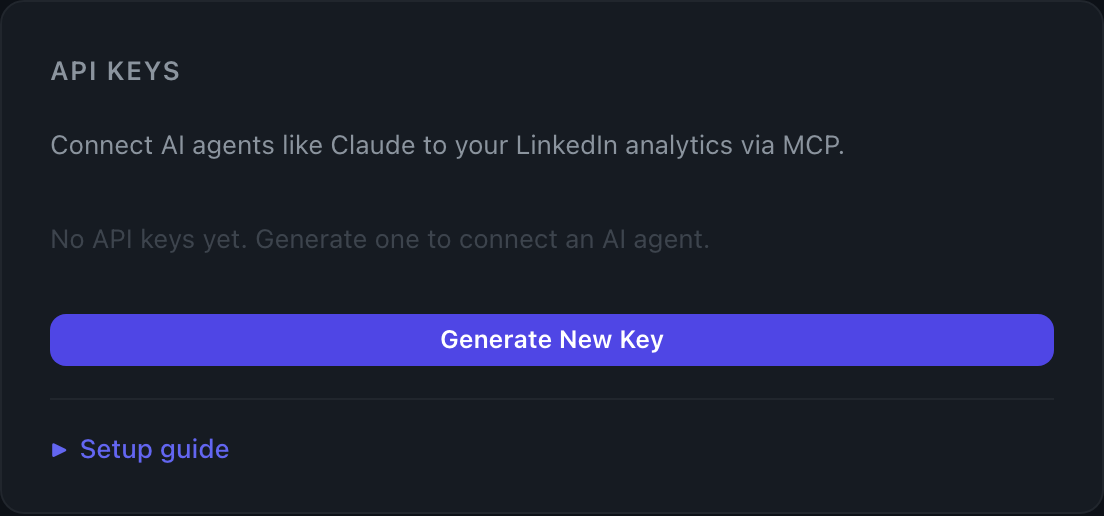
Settings → API Keys -
Add Flux to your MCP client config
For Claude Desktop, edit the config at
~/Library/Application Support/Claude/claude_desktop_config.json(macOS) or%APPDATA%\Claude\claude_desktop_config.json(Windows):claude_desktop_config.json{ "mcpServers": { "flux": { "type": "http", "url": "https://flux.elegantatomics.com/api/mcp", "headers": { "Authorization": "Bearer YOUR_API_KEY" } } } }For Claude Code, drop the same block into
.mcp.jsonat the root of any project:.mcp.json{ "mcpServers": { "flux": { "type": "http", "url": "https://flux.elegantatomics.com/api/mcp", "headers": { "Authorization": "Bearer YOUR_API_KEY" } } } } -
Restart Claude Desktop
Fully quit and relaunch — Claude picks up new MCP servers on boot. In the chat composer you should see a tools indicator showing
fluxis connected. -
Try it
Ask Claude: “List my tracked LinkedIn profiles.” It'll call
list_profilesand show you what's wired up. From there, anything on the tool reference below is fair game.
46 tools, grouped by job.
Every tool Flux exposes over MCP. Most are free; paid tools note their credit
cost. Call get_cost_estimate before any action if you want to
preview spend.
▶ Analytics
6 tools
Query your own post history — KPIs, trends, patterns, and semantic/keyword search.
get_posts
free
Return posts with full metrics and text content for a tracked profile. Supports filtering by date range, post type, minimum engagement, and text search. Pass scope to restrict to a collection. Paginated.
get_profile_summary
free
KPI summary for a tracked profile: total posts, avg engagement (likes/comments/shares/conversation rate), posts per week, engagement trend, top format, and posting goal status.
get_posting_insights
free
Optimal posting patterns for a profile: best day of week, best hour, format performance breakdown, character-length sweet spot. All metrics relative to the user's own baseline. Pass scope to recompute against a collection.
get_engagement_trends
free
Engagement time series with gap-filled buckets, rolling averages, and trend direction. Each bucket includes avg engagement, likes, comments, shares, and conversation rate.
search_posts
free
Search posts by keyword and/or semantic similarity. Full-text search with stemming for keyword matches, pgvector embeddings for semantic matches. Results ranked by relevance.
find_similar_posts
free
Find posts semantically similar to input text using OpenAI embeddings and pgvector cosine similarity. Scope to a profile or a collection. Returns posts sorted by similarity with engagement metrics.
▶ Prediction & drafting
2 tools
Score drafts before you publish and generate fresh angles grounded in your top performers.
score_draft
3 credits
Predict how a draft post will perform against the user's historical data. OLS regression with detrending, ridge regularization, and recency weighting — same model as the /score page. Returns predicted engagement percentile, projected range, factor breakdown, similar past posts, and improvement suggestions.
suggest_angles
5 credits
Given a topic, suggest distinct content angles informed by what performs well in the user's scoped data. Pulls top historical posts as context and asks OpenAI to generate 5 concrete angles.
▶ Streams
7 tools
Always-on research streams — external profiles, companies, topics, hiring signals, ad watches — that pull on a schedule into your library.
list_profiles
free
List all tracked LinkedIn profiles for the authenticated user. Returns profile IDs needed by other tools.
list_streams
free
List all research streams (external profiles, companies, topics, person interests, hiring signals, ad watches, own_profile). Pass type to filter.
create_stream
varies
Create a new research stream. Running it on schedule costs credits — see get_cost_estimate for per-type cost. own_profile streams come from subscription checkout, not this tool.
get_stream_feed
free
Return the most recent posts a stream has collected into the library, newest first by published_at.
pause_stream
free
Pause a stream so it stops running on its cron schedule. Existing posts remain in the library.
resume_stream
free
Resume a paused stream. Queues it to run on the next cron tick.
delete_stream
free
Delete a stream and its runs. Posts it collected stay in your library so historical data isn't lost. own_profile streams can't be deleted here — cancel the subscription instead.
▶ Collections & Segments
13 tools
Collections group posts; segments group people. Both can be smart (predicate-driven) or manual, and both can be resolved into concrete IDs for downstream tools.
list_collections
free
List all post collections for the authenticated user, with member counts.
create_collection
free
Create a new post collection. Manual or smart (predicate-based).
add_to_collection
free
Add one or more posts (by post_id) to a collection. Existing members are silently ignored.
remove_from_collection
free
Remove one or more posts (by post_id) from a collection. Missing members are silently ignored.
resolve_collection
free
Resolve a post collection into a concrete list of post_ids. Works for both manual and smart collections.
list_segments
free
List all audience segments for the authenticated user, with member counts. Segments are named groups of people (e.g. ‘ICP — VPs of Marketing’, ‘Champions’).
create_segment
free
Create a new audience segment. Manual or smart (template-based).
add_to_segment
free
Add one or more people (by person_id) to an audience segment.
remove_from_segment
free
Remove one or more people (by person_id) from an audience segment.
resolve_segment
free
Resolve an audience segment into a concrete list of person_ids.
list_segment_templates
free
List available smart-segment templates. Pass a template id to create_segment to spin up a preconfigured segment.
save_post
1 credit
Save a LinkedIn post to your library by URL. Resolves the post via HarvestAPI and stores it with source_type='saved'. Optionally adds the post to a manual collection. Failed lookups don't charge.
get_alerts
free
Return recent alerts for the authenticated user's streams.
▶ Research (HarvestAPI)
11 tools
On-demand lookups against LinkedIn data via HarvestAPI. Most calls cost 5 credits; results from profile/company post pulls land in your library, and per-post reactions/comments populate the engagement graph so subsequent queries about who-engages-with-what become free.
linkedin_profile_posts
5 credits / page
Fetch recent posts from a LinkedIn person profile. Results also stored in the post library (source_type='external') and linked to a linkedin_profiles row.
linkedin_company_posts
5 credits / page
Fetch recent posts from a LinkedIn company page.
linkedin_post_search
5 credits
Search LinkedIn posts by keyword. Returns a single page of matching posts.
linkedin_profile_reactions
5 credits
Fetch the recent posts a LinkedIn person has reacted to. Useful for inferring interests.
linkedin_profile_comments
5 credits
Fetch the recent posts a LinkedIn person has commented on. Useful for inferring interests and conversation partners.
linkedin_post_reactions
5 credits
Fetch the people who reacted to a single LinkedIn post (with reaction kind). Engagers are persisted to the post_engagements graph.
linkedin_post_comments
5 credits
Fetch the people who commented on a single LinkedIn post (with comment text). Each comment is persisted to post_engagements.
linkedin_people_search
5 credits
Search LinkedIn people by company, title, location, or keywords. Returns a single page of profiles.
linkedin_company_search
5 credits
Search LinkedIn companies by keywords, industry, or location. Returns a single page of companies.
linkedin_job_search
5 credits
Search LinkedIn job postings. Useful for tracking hiring signals at target companies.
linkedin_ad_search
10 credits
Search the LinkedIn ad library. Useful for tracking competitor ad creative and messaging.
▶ Constellation (warm outreach)
8 tools
Map the graph around a target account, score warm paths, prioritize an outreach queue, and log outcomes so acceptance and reply rates build up over time.
create_campaign
free
Create a Constellation outreach campaign. Groups target accounts, people you care about at those accounts, and warm connections you could approach.
add_campaign_accounts
free
Add one or more target companies to a campaign. map_constellation is then run per-account.
map_constellation
up to ~175 credits
Map the professional graph around a target company. Finds senior decision-makers, pulls each target's recent posts/reactions/comments to identify engagers, scores every connection, and produces a prioritized outreach queue. Scales with max_targets; actual cost is reported in the response.
score_connections
free
Re-score all constellation entries in a campaign and rewrite queue positions from highest to lowest composite score. Run after new engagers or targets are added.
get_outreach_queue
free
Return the prioritized outreach queue for a campaign, sorted by composite score. Each entry includes person details, pool (coworker/engager/mutual), recommended action, and prior log entries.
get_engagement_brief
free
For a Constellation target, return the handful of their recent posts that most closely overlap with the topics you post about yourself — plus suggested talking points. Use before a warm comment or DM.
log_outcome
free
Append an entry to the outreach log: connection requests, acceptances, replies, or no-responses. Feeds get_campaign_stats.
get_campaign_stats
free
Summary stats for a campaign: target count, entry count, outreach volume, and acceptance / reply rates broken down by pool and score tier.
▶ Admin & billing
3 tools
Visibility into credit balance, tool pricing, and recent usage.
get_credit_balance
free
Return the authenticated user's current credit balance, this period's monthly allocation, and credits used since the period started.
get_cost_estimate
free
Given an MCP tool name, return its credit cost so you can preview an action before running it. Returns { tool_name, cost, balance, sufficient }.
get_usage_history
free
Recent credit_ledger transactions for the authenticated user. Filter by tool, reason, or date range. Paginated.
Three kinds of people get the most out of it.
Workflow builder
Wires Flux into daily routines. Morning ritual: ask Claude what moved overnight, which drafts are worth finishing, who's worth reaching out to. The dashboard becomes optional.
Agency
Lets clients query their own data without learning a dashboard. Every client gets a key; Claude becomes the universal interface across the book of business.
Operator
Automates repeat analyses. Weekly engagement reviews, quarterly content retros, monthly outreach stand-ups — all scripted as prompts Claude reruns on demand.
Questions.
score_draft is 3 credits, suggest_angles is 5, each HarvestAPI research call is 1, and map_constellation scales with your target count (capped around 175). Call get_cost_estimate first to preview.One sentence away from your data.
Edge is $10/month. Cancel anytime. The MCP key is ready the moment you land in Settings.