1
Star rating + percentile
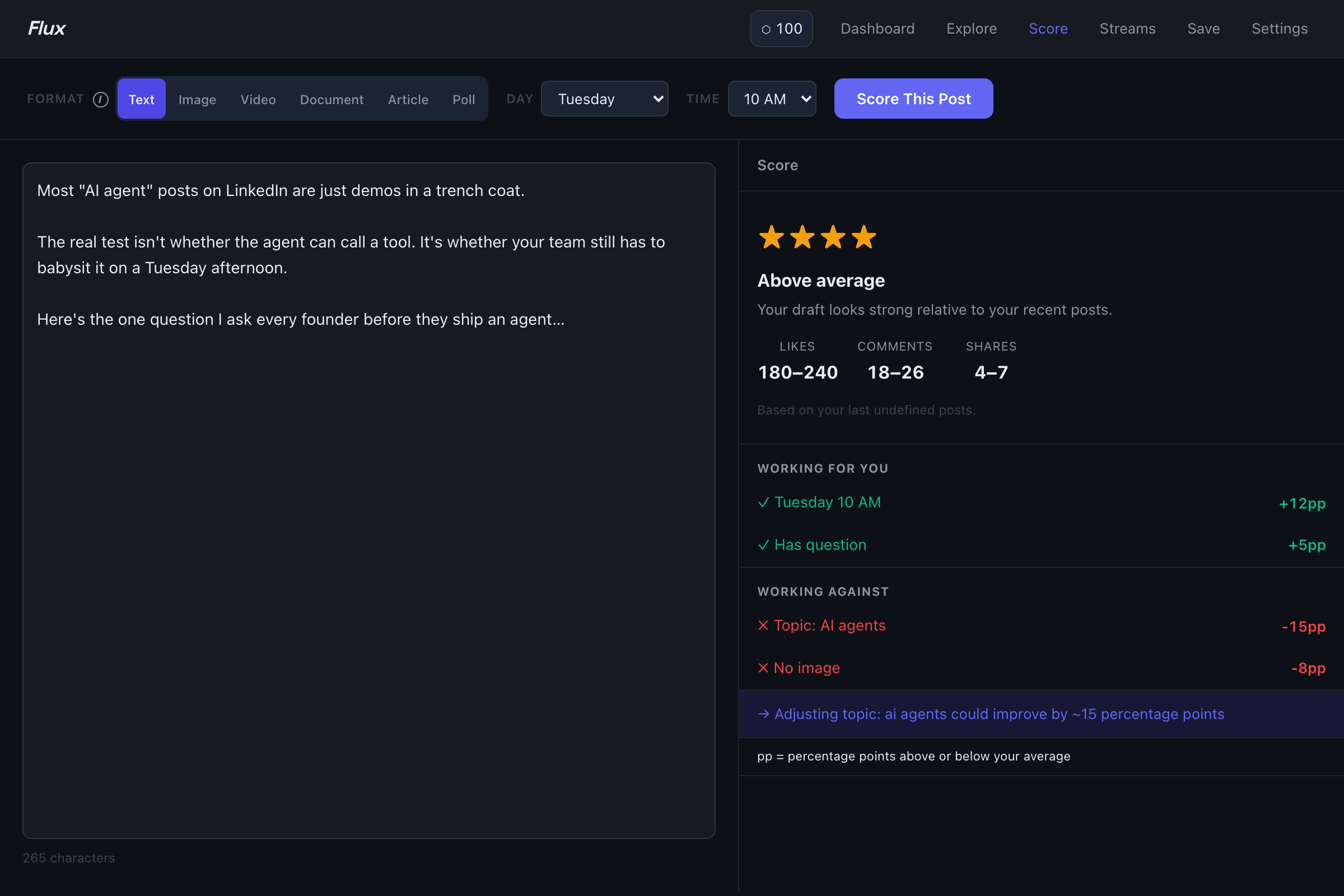
Where this draft sits vs your last 90 days. A 4-star prediction means it's projected in your personal top 25%.
Score My Post · Edge feature
Paste your draft. Flux scores it against your past posts — your topic mix, your audience, your style — and tells you what'll drive or drag engagement before you hit publish.
You've probably said one of these out loud this month.
“I post by feel and hope something lands.
“Some posts flop and I have no idea why.
“My coach's generic advice ('shorter posts, post at 9am Tuesday') doesn't match my audience.
Every score runs against your actual post history — not a generic benchmark, not someone else's audience.
Where this draft sits vs your last 90 days. A 4-star prediction means it's projected in your personal top 25%.
Low / mid / high bounds for likes, comments, and shares — scaled to your current audience size, not a historical snapshot. So you calibrate expectations before you publish.
Every signal the model saw, ranked by impact in percentage points (pp):
The 3–5 closest posts from your history by topic, with their actual engagement and percentile rank. See what worked, what didn't, and why.
A concrete next step, not platitudes. Like: “You tend to do 23% better on image posts — add a visual.” Or: “Adjusting post length could improve by ~8 percentage points.”
How it works
Flux trains a lightweight prediction model on your post history using OLS regression with recency weighting (120-day half-life, so last month counts more than last year). No generic advice — the model only knows what your audience has done. Ridge regularization prevents overfitting to your last five posts. It updates automatically as you publish new posts, and a topic signal from semantic embeddings blends in on drafts where you have similar past content. You can read the code if you want to; it's the same math that runs in your browser for the rest of the dashboard.
Who it's for
Three people who use Score My Post every week.
The daily poster
Testing format variations
You post 3–5x a week. Score My Post tells you whether this week's experiment is likely to outperform last week's winner — before you commit a slot to it.
The coach
Scoring a client's draft
Your client sends you a draft at 9pm. You paste it into their Flux account and send back a star rating, a factor breakdown, and a concrete tip — grounded in their history, not your taste.
The consultant
Two posts a week, both must land
You don't have time for post-mortems on dud posts. Score a draft, see the factors working against it, iterate in 30 seconds, publish with a prediction you trust.
Tier availability
Score My Post lives on the Edge tier — $15/mo, alongside semantic Explore, MCP access, growth-adjusted metrics, and ranked factors.
Because the prediction is only as good as fresh data — and that’s what Edge’s embedding + refresh pipeline is for. Daily data pulls, embeddings computed as you post, model retrained automatically.
See pricingKeep exploring
Score My Post is one piece. Here's what else unlocks at $15/mo.
MCP · Agents
Connect Claude to your data
Query your posts, search by meaning, score drafts — from inside Claude, Cursor, or any MCP client. 40+ tools over HTTP.
Explore MCP →
Explore · Semantic search
Search your history by meaning
"Posts where I talked about hiring that flopped." Find the pattern, not the keyword. Hybrid search over your full archive.
See Explore →
Dashboard · Analytics
Growth-adjusted performance
Engagement trends, format breakdown, ranked content factors, and predicted-vs-actual on every post. In-browser DuckDB, no dashboards to wait for.
See Dashboard →
No generic tips. Trained entirely on your history.